

Newsroom
Go backHow glaas is made of weighing several hundred kilograms?
22-06-2026
Contemporary architecture increasingly relies on light, space, and large glazing. We encounter them not only in office buildings but also in modern single-family homes and apartments. Few people, however, consider the significant technological and logistical challenge of producing glass weighing several hundred kilograms. This is commonplace for glass processors, but for many investors and joinery manufacturers, it remains an invisible process. In this article, we show the step-by-step process of creating large-scale safety glass and why TPS® technology, currently being implemented at MATPOL, opens up new possibilities in the production of insulating glass unit
The Float Process as the Starting Point
It all begins in the glassworks, where a mixture of mineral raw materials, including quartz sand, soda, limestone, and dolomite, is melted at very high temperatures. The liquid glass then hits the surface of liquid tin. This float process produces a perfectly flat sheet of glass, which can later be used to produce large-scale glazing. Once the glass is formed, it is annealed, and if necessary, functional coatings are applied for thermal insulation and solar control.
For glass weighing several hundred kilograms, one of the key parameters is the appropriate thickness of the individual glass panes. In standard construction, individual glass panes in a glazing unit are typically 4-6 mm thick. For XXL formats, reaching dimensions of up to 6000 x 3210 mm, individual glass panes are used that are 8, 10, or even 12 mm thick.
The glass mass increases very rapidly. It is assumed that 1 m² of 1 mm thick glass weighs approximately 2.5 kg. This means that a 6 m² double-glazed unit, made of three 8 mm panes, weighs approximately: 6 m² × 24 mm × 2.5 kg = 360 kg. To this must be added the weight of spacers, seals, and other components.
Mechanical and CNC machining, the process of processing large sheets of glass
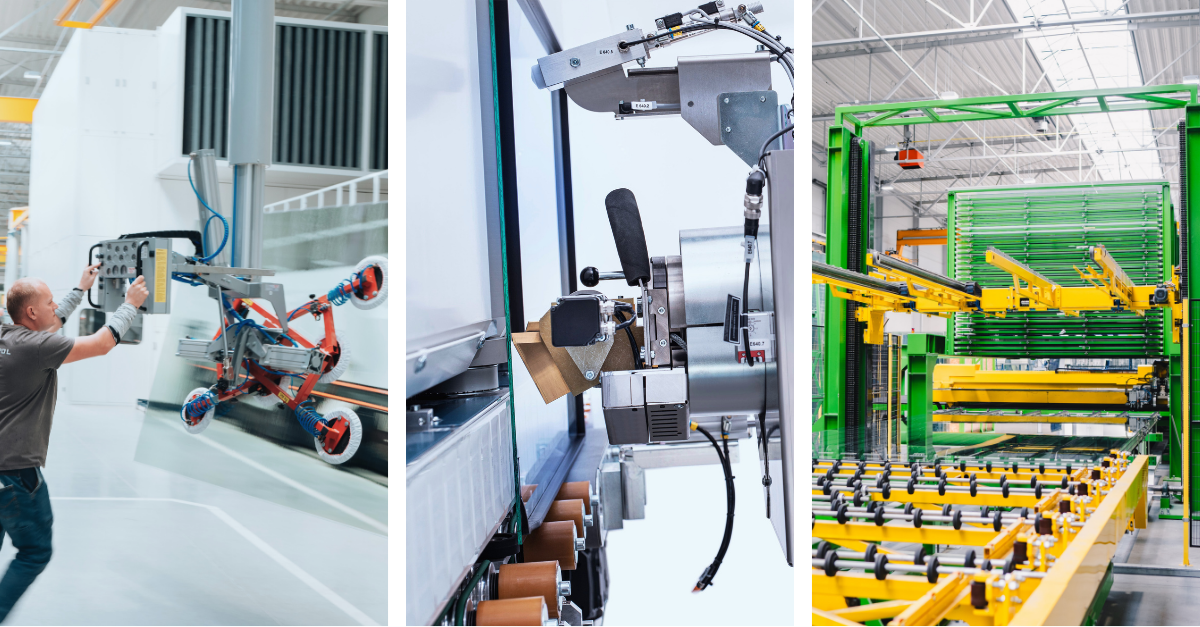
When full sheets of glass arrive at our plant, precision machining begins. Working with components weighing up to several hundred kilograms requires not only modern machinery but also experienced operators and a carefully designed production organization.
Automatic Cutting
The first stage is glass cutting. Automated technological lines for storing and cutting glass, as well as optimization systems, allow for obtaining the required formats while maintaining very high accuracy and maximum material utilization.
Edge Processing
The glass undergoes edge grinding. This is an extremely important step, as it eliminates micro-damage caused during cutting and significantly increases the safety and durability of the finished product.
Drilling and Milling
Depending on the project, holes, cutouts, and undercuts are also made, necessary for subsequent installation of the glass into the building structure.
Safety First – Tempering and Laminating
For large-scale glazing, user safety is crucial. Therefore, glass undergoes processes that increase its strength and minimize the effects of potential damage.
Tempering involves heating and rapidly cooling the glass. This increases its mechanical strength several times over, and if shattered, it shatters into small fragments.
Lamination involves permanently bonding two or more glass panes using a special film. This ensures that even after shattering, the shards remain adhered to the interlayer, significantly increasing user safety.
TPS® Insulating Glass at MATPOL
The final stage of production is the production of the insulating glass unit, whose parameters directly impact the thermal insulation, tightness, and durability of the entire glazing. In the case of large-scale structures, the method of creating the spacer zone and sealing the unit is particularly important.
At MATPOL, we are currently implementing reactive TPS® (Thermo Plastic Spacer) technology, which replaces traditional spacers with a flexible thermoplastic material applied directly to the glass surface. This solution reduces thermal bridges, improves the unit’s tightness, and more effectively compensates for stresses arising from temperature changes and operational loads.
One of the key advantages of TPS® is its ability to create a permanent chemical bond between the spacer material, the glass, and the secondary seal. This creates a uniform, monolithic sealing zone that effectively protects the unit’s interior from moisture ingress and gas loss for years to come.
An additional advantage is the high level of process automation. The material is applied continuously and in a fully controlled manner, ensuring consistent quality, precise geometry, and high precision, even with the largest glass sizes.
Aesthetics are also important. The uniform, matte surface of the spacer zone eliminates the visible frame joints in traditional glass, making the edge of the unit more discreet and harmoniously complementing modern joinery and large-format glazing.
Quality Control and Logistics
Before the finished package reaches the customer, it undergoes quality control. Special scanning systems detect even the smallest surface defects or coatings at earlier stages of production.
After the assembly process is complete, the glass is transported using specialized racks. With components weighing several hundred kilograms, each step—from production, through transport, to assembly—requires precise planning and safety.
The production of large-size glass is a process that combines advanced technology, expert experience, and rigorous quality control. Thanks to modern solutions such as TPS®, it is now possible to create glazing of increasingly larger dimensions, improved insulation, and higher durability, meeting the requirements of modern architecture.
For MATPOL, this investment opens up new possibilities in the production of large-size insulating glass units and allows for the implementation of projects with technical parameters and workmanship that set new standards in the Polish market.